

Bone Spur on Your Ankle? Here’s What That Bump Actually Means
August 20, 2026
You rolled your ankle stepping off a kerb or coming down awkwardly from a jump, and now it’s swollen and every step lands wrong. The question forms almost immediately: how long is this going to keep you out?
Most ankle sprains take one to six weeks before walking feels normal again, though a severe tear can take three months or longer before the ankle feels fully trustworthy. Recovery time depends on how much ligament damage occurred, how quickly you started managing it, and how much rehabilitation work you actually put in afterward.
A quick overview before the detail:
| Severity | Typical timeframe for comfortable walking | Full return to sport |
| Grade 1 (mild stretch) | Several days to two weeks | Two to four weeks |
| Grade 2 (partial tear) | Two to six weeks | Six to eight weeks |
| Grade 3 (complete tear) | Six weeks or more | Three months or more |
These are general ranges, not guarantees. Two people with the same grade of sprain can heal at noticeably different speeds.
I am text block. Click edit button to change this text. Lorem ipsum dolor sit amet, consectetur adipiscing elit. Ut elit tellus, luctus nec ullamcorper mattis, pulvinar dapibus leo.
What Is an Ankle Sprain?
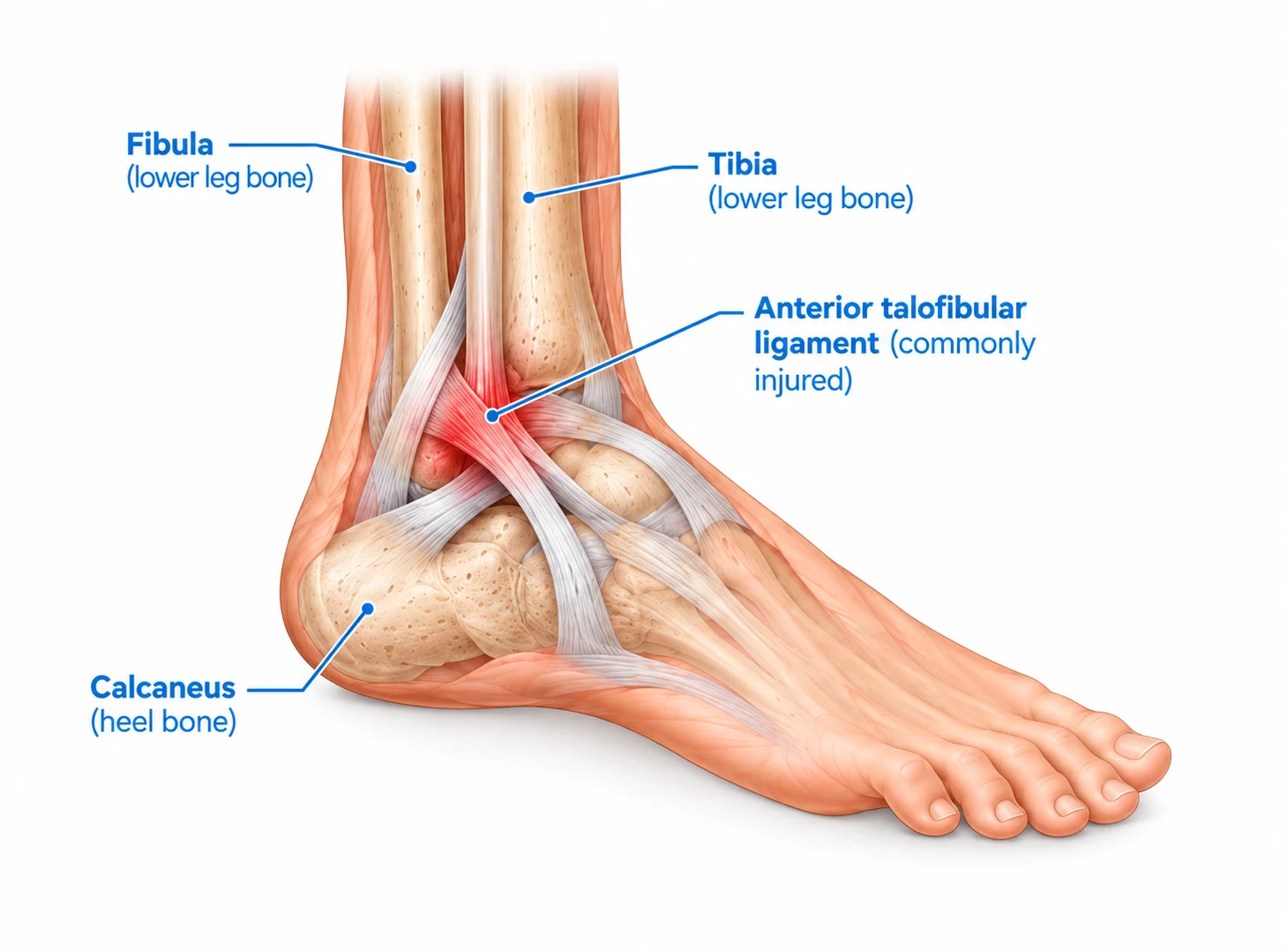
An ankle sprain happens when the ligaments holding your ankle bones together get stretched beyond their normal range or tear. Ligaments are tough, fibrous bands of tissue; they connect bone to bone and keep the joint stable. Most sprains happen when the foot rolls inward, stressing the ligaments on the outside of the ankle.
Ankle Ligament Injury vs. Ankle Ligament Tear
“Ankle ligament injury” is the umbrella term. It covers everything from a mild overstretch to a complete tear. “Ankle ligament tear” is more specific: some or all of the fibers have actually ruptured. Every tear is an injury; not every injury is a tear. The grading system below is really just a way of describing how far along that spectrum your particular sprain sits.
What Are the Symptoms of an Ankle Sprain?
Symptoms typically include:
- Pain, sharpest right at the moment of injury
- Swelling, sometimes within minutes, sometimes overnight
- Bruising that can spread down toward the toes
- Tenderness when you press around the outer ankle bone
- Difficulty putting full weight on the foot
- A feeling that the ankle might “give way”
Why Is Ankle Still Swollen After a Sprain?
Swelling after a sprain comes from fluid and blood pooling around the damaged tissue as the body starts repairing it. Mild swelling can linger for two to three weeks; it’s a normal part of the healing process, not a sign something’s gone wrong. Swelling that’s still significant past three to four weeks, or that gets worse instead of better, is worth having checked.
Why Does Ankle Still Hurt After a Sprain?
Ongoing ankle pain after a sprain usually means the tissue is still healing, or the joint hasn’t regained its normal strength and range of motion yet. Ligaments take longer to heal than muscle; even a mild sprain can leave a dull ache for several weeks after the swelling’s gone down. Pain that’s sharp, localised to one specific spot on the bone, or that doesn’t ease at all over two to three weeks deserves a closer look.
What Are the Different Grades of Ankle Sprains?
Ankle sprain grades describe how much ligament damage occurred. This is one of the biggest factors in how long recovery actually takes.
Grade 1 Ankle Sprain
A mild stretch with little to no tearing. Swelling is usually minor, and you can generally bear weight, even if it’s uncomfortable.
Grade 2 Ankle Sprain
A partial tear. Expect more swelling, bruising, and noticeably reduced stability. Walking is usually possible but limps.
Grade 3 Ankle Sprain
A complete tear of one or more ligaments. Significant swelling, marked instability, and often real difficulty bearing weight at all.
Grade doesn’t map to a fixed number of days. It sets the general range; how you manage the injury in the first week shifts you toward the faster or slower end of that range.
Ankle Sprain Recovery Timeline
First 24 to 72 Hours
Swelling and pain peak. This is the window for protecting the joint, controlling swelling, and avoiding anything that stresses the ligament further.
The First 1 to 2 Weeks
For grade 1 sprains, weight-bearing usually starts feeling more natural. Grade 2 and 3 sprains are often still swollen and unstable at this stage, and that’s expected, not a red flag on its own.
Weeks 2 to 6
This is where sprained ankle recovery time diverges most between grades. Mild sprains are often back to normal daily activity. Moderate to severe sprains are typically still working through structured rehab: rebuilding range of motion, then strength, then balance.
After 6 Weeks
Most people are walking without a limp by this point. Severe ankle sprain recovery time can genuinely run past this mark, particularly for return to running, cutting, or jumping sports, where the ankle needs full strength and proprioception restored, not just an absence of pain.
Persistent swelling, pain, or a sense of instability well past these windows isn’t something to just wait out. It’s a reasonable prompt for reassessment.
What Can Help an Ankle Sprain Recover?
A few principles guide sensible recovery, roughly in order:
- Protect the ankle early. Avoid activities that reproduce the pain or instability in the first days.
- Manage pain and swelling. Elevation and gentle compression are commonly used in the early phase.
- Restore movement gradually. Stiffness sets in fast if the ankle isn’t moved at all.
- Rebuild strength. Weakened muscles around the joint are a major reason sprains recur.
- Retrain balance. The ankle’s sense of its own position (proprioception) is often the last thing to fully recover and the first thing people skip.
- Return to activity in stages. Jumping straight back to full training is one of the more common ways a sprain becomes a second, worse sprain.
This isn’t a substitute for individual guidance; how aggressively you progress depends on your specific injury.
Ankle Sprain Recovery Exercises
Exercise progression should track how the ankle actually feels, not a fixed calendar.
Range-of-Motion Exercises
Gentle ankle circles and alphabet tracing (drawing letters in the air with your toes) help restore movement without loading the joint heavily.
Strengthening Exercises
Resistance band work targeting the muscles around the ankle, once acute pain has settled, rebuilds the support the ligament used to provide alone.
Balance and Stability Exercises
Single-leg standing, progressing to unstable surfaces, retrains the proprioception that ligaments contribute to joint awareness. This step gets skipped constantly, and it’s a big part of why some ankles keep giving way months later.
Returning to Sport and Exercise
Sport-specific movement (cutting, pivoting, jumping) comes last, once strength and balance are close to matching the uninjured side. Rushing this stage is a common cause of re-injury.
When Should You See a Doctor for a Sprained Ankle?
See a doctor if you cannot bear any weight on the ankle, if swelling or pain is severe, if there’s visible deformity, or if symptoms aren’t improving the way you’d expect over a couple of weeks. These signs can indicate that the injury needs further assessment.
Other situations worth a proper assessment:
- Pain concentrated over a specific bone rather than general soreness
- Repeated sprains on the same ankle
- A sense the ankle keeps “giving way” during normal activity
- Symptoms that plateau instead of gradually improving
Clinicians sometimes use tests like the anterior drawer test to check ligament laxity, but these are more reliable once the acute swelling has settled, usually four to five days after injury, rather than in the emergency-room moment itself. That’s part of why a short course of rest and reassessment, rather than an instant verdict, is often the more accurate path.
Can an Ankle Sprain Cause Chronic Ankle Instability?
A sprain that isn’t fully rehabilitated, or one that recurs, can lead to chronic ankle instability: an ongoing sense that the joint is unreliable, with repeated giving-way episodes. This isn’t universal, and it isn’t inevitable. It’s more closely tied to incomplete rehab, particularly skipped balance and strength work, than to the original injury alone.
How Can You Reduce the Risk of Another Ankle Sprain?
- Finish the full rehabilitation course, including balance work, even once pain is gone
- Keep ankle and lower-leg strength up as an ongoing habit, not a one-off
- Choose footwear appropriate to the activity, especially on uneven ground
- Get a previous sprain properly assessed if it never quite felt “right” again
An ankle that’s fully rehabilitated is a genuinely different joint to one that’s just stopped hurting.
Recovery That Actually Holds
Time alone doesn’t fix an ankle. Rehabilitation does. Two people can walk out of the same injury on the same day and end up in very different places six months later, and the difference usually isn’t luck. It’s whether the balance work got done after the pain stopped.
If your ankle is still swollen, unstable, or giving way well past the timeframes above, that’s not something to just wait out. Schedule an assessment with our foot, ankle and knee specialist to check whether the ligament has healed the way it should or whether it needs a closer look.
FAQs
Most sprains take one to six weeks before normal walking feels comfortable. Mild sprains often resolve within two weeks; severe tears can take three months or more, particularly for a full return to sport.
It depends mainly on grade. A grade 1 sprain is often manageable within days to two weeks. A grade 3 tear typically needs six weeks or longer before the ankle feels stable again.
Mild sprains often allow some weight-bearing early on, with discomfort. Moderate to severe sprains may make walking difficult or unsafe in the first few days. Inability to bear any weight is a reason to get assessed rather than push through.
Range-of-motion work first, then strengthening, then balance and stability training, progressing in that order as pain allows. Balance work is the stage most often skipped, and skipping it is linked to recurring sprains.
Ligaments heal slower than muscle, so mild aches can persist for weeks after swelling settles. Sharp, localized pain over a bone, or pain that isn’t improving at all after two to three weeks, is worth having checked.
See a doctor if you can’t bear weight at all, if swelling or pain is severe, if there’s visible deformity, or if symptoms aren’t improving as expected. Repeated sprains on the same ankle are also worth assessing.
Yes, particularly when rehabilitation is incomplete or the sprain recurs before it’s fully healed. It’s not automatic; it’s more strongly linked to skipped strength and balance work than to the injury itself.