

Flat Feet Surgery Recovery Time: What to Expect After Reconstruction
August 10, 2026
How Long Does an Ankle Sprain Take to Heal? Recovery Timeline and Tips
September 22, 2026

You noticed it in the shower. Or maybe pulling on a sock. A hard little ridge on your ankle that definitely wasn’t there a year ago, sitting right where your shoe rubs.
Now you’re three tabs deep into a search for an ankle bone spur, half-convinced it’s arthritis, half-hoping it’s nothing.
Here’s the direct answer: An ankle bone spur, also called an osteophyte, is extra bone growth that forms along a joint surface, usually where cartilage has worn down or where a joint has been subjected to repeated stress over time. Most are small, slow-growing, and painless for years. Some become a real problem. The difference comes down to location, size, and whether they’re catching on nearby tendons or restricting how far your ankle bends.
That’s the short version. The rest of this piece walks through where these spurs typically form, what they actually look like, three things people get wrong about them, and how to tell the harmless kind from the kind worth booking an assessment for.
What's Actually Growing There
Bone doesn’t grow bumps for no reason. An osteophyte forms because the body is responding to friction, instability, or mechanical stress at a joint edge, laying down new bone the way a callus forms on skin that keeps getting rubbed.
In the ankle, that stress usually traces back to one of three things: years of low-grade cartilage wear, a joint that’s been repeatedly sprained and never quite stabilised, or a single hard impact that changed how the joint sits. The spur itself isn’t the injury. It’s the body’s slow, clumsy attempt to reinforce a joint it perceives as under threat.
This matters for how you think about treatment. You’re not managing a growth. You’re managing whatever mechanical problem caused the growth in the first place.
Where They Show Up: Talus, Malleolus, and the Front of the Joint
Not all ankle bone spurs sit in the same place, and location changes both the symptoms and the name.
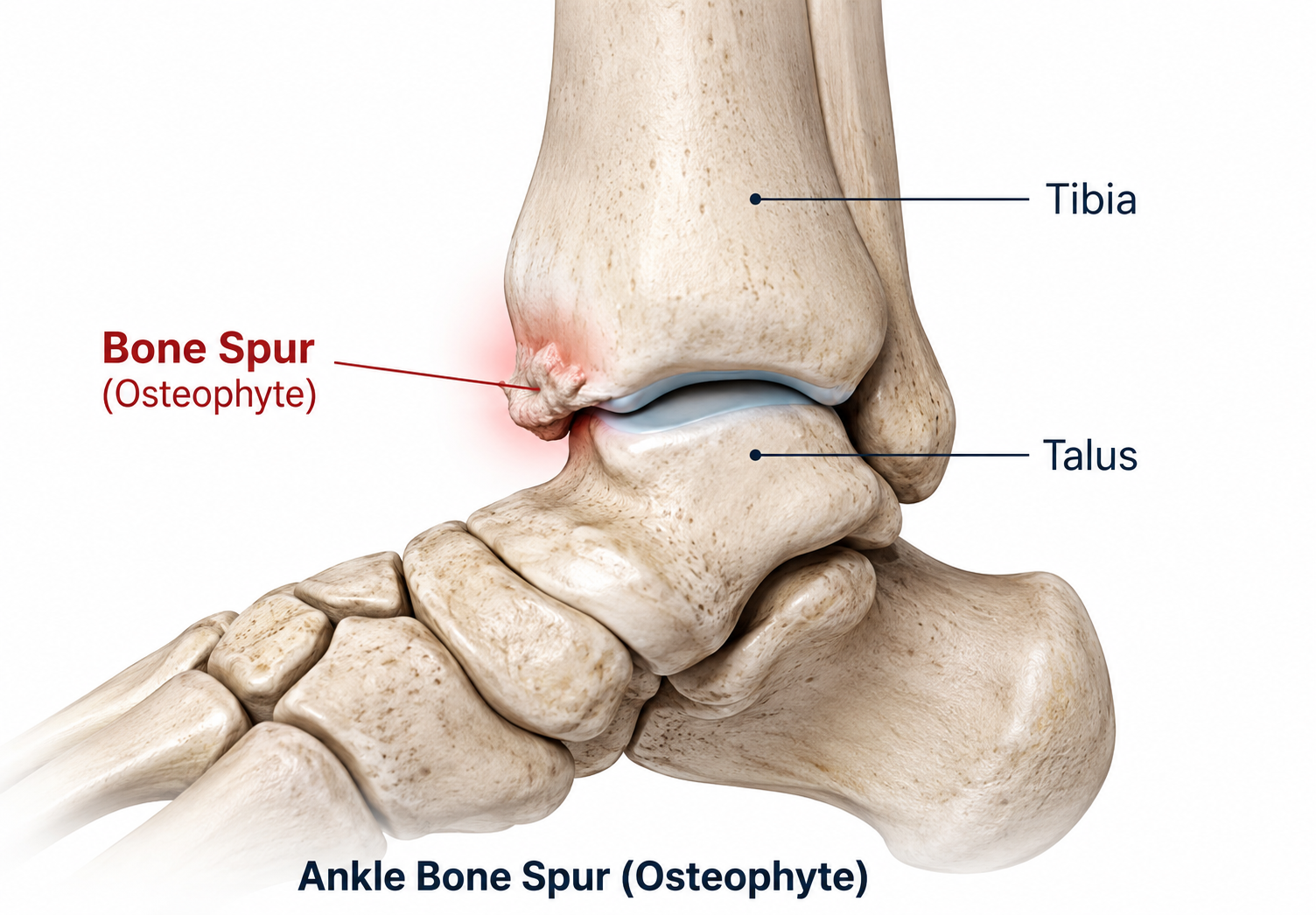
A talus bone spur forms on the talus, the bone that sits between your shin bones and your heel, forming the core of the ankle joint. Spurs here often develop on the front edge of the talus, right where it meets the shin bone during upward foot movement, which is why they tend to bite hardest when you’re squatting, cycling, or walking downhill.
A spur near the lateral malleolus, the bony bump on the outside of your ankle, usually points to a different cause: repeated lateral ankle sprains. Every time the outer ligaments stretch or tear slightly and heal imperfectly, the joint edge takes a bit more shear stress than it’s built for.
Spurs at the front of the joint, sometimes described loosely as ankle spurs or a growth on ankle bone, tend to show up in people who’ve spent years doing sports with repetitive forced ankle bending: dancers, footballers, anyone who’s spent a decade landing hard on the same joint.
What It Looks Like
People searching for pictures of this usually want one thing confirmed: does what I’m feeling match what a bone spur actually looks like?
Picture a firm, bony ridge, not a soft lump. It sits directly over the bone rather than floating loosely under the skin the way a cyst or ganglion would. It doesn’t move when you press it. Depending on location, it might be barely visible, just a slightly more prominent contour on one side of the ankle, or pronounced enough to catch on shoe lining and cause a visible red patch from friction.
Colour and swelling around it matter more than the bump’s size. A pale, painless bump that’s been stable for years is a different story than one that’s suddenly red, warm, or growing.
Three Things People Get Wrong About Bone Spurs
“It’s just a calcium deposit.” Not quite. Calcium is a building block of bone, sure, but a bone spur isn’t loose calcium sitting under the skin. It’s structured bone tissue, continuous with the bone underneath it, grown in response to stress. You can’t dissolve it with diet changes.
“It’ll go away on its own.” Usually not. Once bone has remodelled itself into a spur, it tends to stay unless the underlying mechanical cause changes. What often does improve is the pain around it once the joint stops being aggravated.
“If I have one, I’ll need surgery.” It’s rarely the first move. Most spurs are managed without an operation: footwear changes, activity modification, and physiotherapy to improve joint mechanics. Surgery becomes a conversation when the spur is mechanically blocking movement or the joint underneath it has become unstable, not simply because the spur exists.
Can a Bone Spur Cause Anterior Ankle Impingement?
Sometimes, yes, and this is the mechanism worth understanding if your ankle feels stiff rather than just sore.
Anterior ankle impingement happens when bone or soft tissue at the front of the ankle joint gets pinched between the shin bone and the top of the foot during upward bending, the same movement you use walking uphill or squatting. A spur sitting right at that junction is a common physical cause: it narrows the space available, and the joint literally runs out of room before your foot does.
The tell is usually a sharp, pinching pain at the front of the ankle specifically during dorsiflexion (that upward bend), rather than a dull ache at rest. Footballers and dancers see this often enough that it’s sometimes called footballer’s ankle, a description for the same anterior impingement pattern in athletes whose sport demands repeated forced ankle flexion.
If that pinching sensation is what’s bringing you here rather than a bump you noticed by accident, that’s a more specific problem than a spur alone, and it’s worth naming clearly when you talk to a specialist.
When It's Nothing to Worry About, and When It's Worth a Look
Most ankle bone spurs sit quietly for years and never need treatment. A handful of signs suggest it’s worth getting checked rather than watching:
- Pain that’s new, worsening, or waking you at night
- A pinching or catching sensation during ankle movement, not just tenderness on touch
- Reduced range of motion in comparison to the other ankle
- Recurrent swelling around the same spot
- A history of repeated ankle sprains on that side
None of these confirm anything on their own. They’re the difference between “mention it at your next check-up” and “book something sooner”.
What Treatment Actually Looks Like First
Conservative care comes first for the overwhelming majority of cases. That usually means footwear with more room in the toe box and heel, a course of physiotherapy aimed at improving ankle mechanics rather than just stretching, and activity modification during flare-ups rather than permanent avoidance.
For persistent inflammation, an injection-based approach may be considered before anything surgical. The goal at every stage is the same: settle the joint down, address whatever’s driving the stress on it, and only escalate if that doesn’t hold.
When Surgery Enters the Conversation
Surgery becomes a genuine option when a spur is mechanically restricting the joint, when anterior impingement doesn’t respond to conservative management, or when the spur has developed alongside chronic ankle instability that keeps causing repeat injury.
That last point matters. Ankle sprains that go unaddressed can weaken the joint over time, and repeated sprains are a known path toward chronic instability and, eventually, early joint changes, including arthritis. A bone spur that shows up after years of an ankle that keeps “giving way” often fits that same pattern: a late sign of instability, not the primary problem. Treating the spur in isolation, without addressing the instability underneath it, tends to be a short-term fix.
Where This Leaves You
A bone spur on its own is rarely an emergency. What it usually is: a signal that a joint has been under more stress than it was designed for for longer than you probably realised.
If what you’re feeling is a firm bump with no real pain, that’s worth mentioning at a routine visit. If it’s pinching, restricting movement, or tied to an ankle that’s sprained more than once, that’s a different conversation, and it’s one worth having with someone who can actually look at the joint.
Contact the Clinic to have it properly assessed.
Where This Leaves You
A bone spur on its own is rarely an emergency. What it usually is: a signal that a joint has been under more stress than it was designed for for longer than you probably realised.
If what you’re feeling is a firm bump with no real pain, that’s worth mentioning at a routine visit. If it’s pinching, restricting movement, or tied to an ankle that’s sprained more than once, that’s a different conversation, and it’s one worth having with someone who can actually look at the joint.
Contact the Clinic to have it properly assessed.
Frequently Asked Questions
What is a bone spur on the ankle?
A bone spur, or osteophyte, is an extra growth of bone that develops along the edge of a joint. In the ankle, it can form because of repeated stress, previous injuries, cartilage wear, or arthritis. Many ankle bone spurs cause no symptoms, while others can cause pain, stiffness, or restricted movement.
What does an ankle bone spur look like?
An ankle bone spur may appear as a firm, hard bump or ridge over the affected joint. Some spurs are not visible from the outside and are only identified through imaging such as an X-ray. A new, painful, swollen, or rapidly changing lump should be assessed by a medical professional.
Can an ankle bone spur go away on its own?
An established bone spur usually does not disappear on its own. However, symptoms caused by the spur can improve with treatment such as activity modification, appropriate footwear, physiotherapy, and management of the underlying joint problem.
Can a bone spur cause ankle pain?
Yes. An ankle bone spur can cause pain when it irritates surrounding tissues or interferes with normal joint movement. Spurs at the front of the ankle can also contribute to anterior ankle impingement, causing pinching pain during movements such as squatting or walking uphill.
Can an ankle bone spur cause anterior ankle impingement?
Yes. A bone spur at the front of the ankle can reduce the available space between the tibia and talus during dorsiflexion. This can cause anterior ankle impingement, typically producing pain or pinching at the front of the ankle when the foot bends upward.
Do ankle bone spurs require surgery?
No. Most ankle bone spurs are initially managed with conservative treatment. Surgery may be considered when the spur causes persistent symptoms, significantly restricts movement, contributes to impingement, or does not respond adequately to non-surgical treatment.
When should I see a doctor about an ankle bone spur?
Consider an assessment if the bump is painful, increasing in size, associated with swelling, causes catching or pinching, limits ankle movement, or occurs alongside repeated ankle sprains or instability.